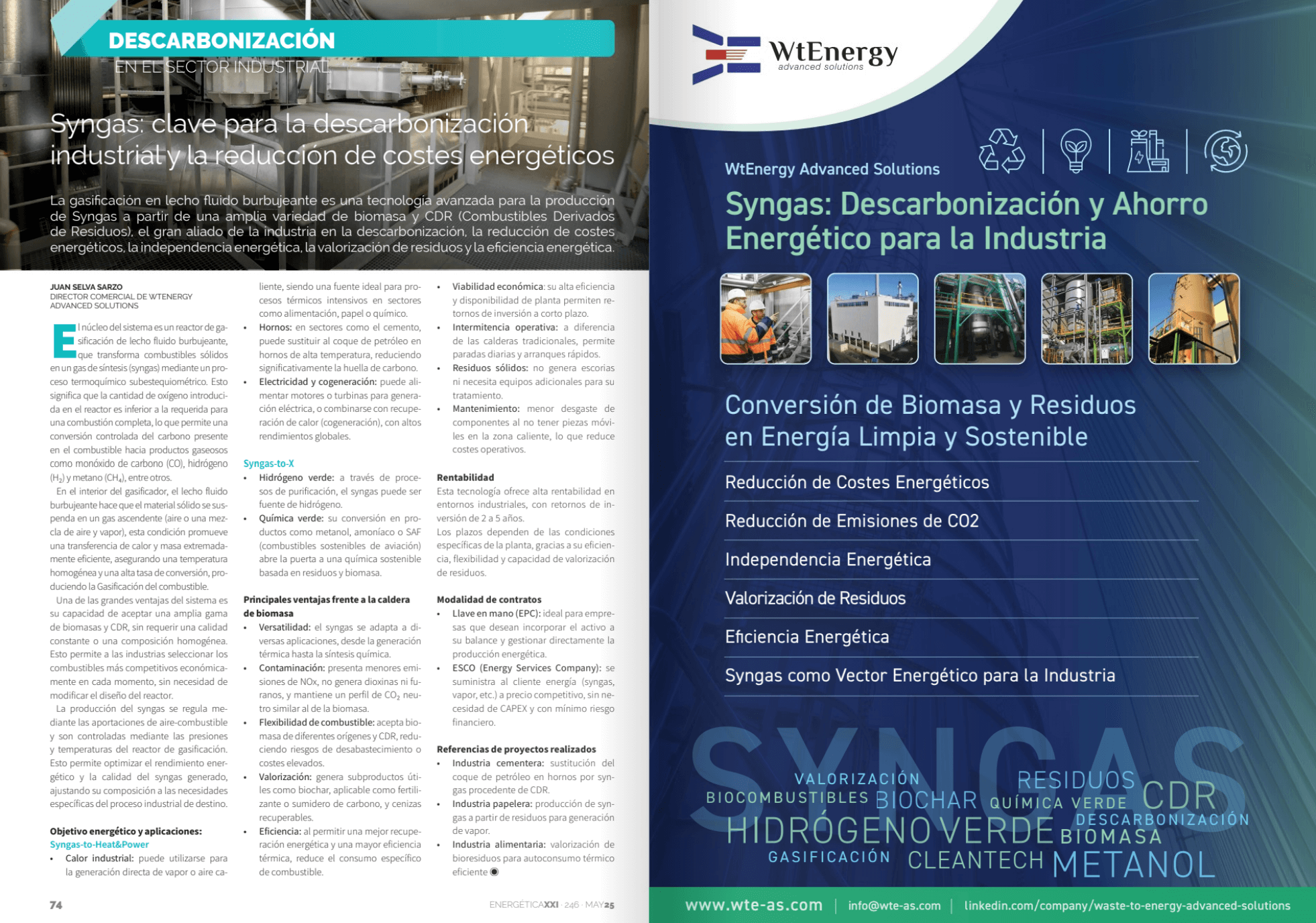
Article written by Juan Selva Sarzo, Commercial Director of WtEnergy Advanced Solutions, and published in the May 2025 edition of Revista Energética 21.
Bubbling fluidized bed gasification is an advanced technology for the production of Syngas from a wide variety of biomass and RDF (Refuse-Derived Fuels). It is becoming a key ally for industry in achieving decarbonization, lowering energy costs, increasing energy independence, valorizing waste, and improving energy efficiency.
At the heart of the system is a bubbling fluidized bed gasification reactor that transforms solid fuels into synthesis gas (Syngas) through a substoichiometric thermochemical process. This means that the amount of oxygen introduced into the reactor is lower than what is required for complete combustion, enabling controlled conversion of the carbon in the fuel into gaseous products such as carbon monoxide (CO), hydrogen (H₂), and methane (CH₄), among others.
Inside the gasifier, the bubbling fluidized bed causes the solid material to be suspended in an upward-flowing gas (air or a mixture of air and steam). This condition promotes extremely efficient heat and mass transfer, ensuring homogeneous temperature and a high conversion rate, thereby producing fuel gas.
One of the key advantages of the system is its ability to accept a wide range of biomass and RDF, without requiring consistent quality or homogeneous composition. This allows industries to choose the most economically competitive fuels at any given time, without needing to modify the reactor design.
The production of Syngas is regulated by adjusting air-fuel inputs and is controlled via the pressures and temperatures within the gasification reactor. This enables optimization of energy performance and syngas quality, adapting its composition to the specific needs of the end industrial process.
Energy Objectives and Applications:
Syngas-to-Heat&Power
Industrial heat: can be used for the direct generation of steam or hot air, making it ideal for heat-intensive processes in sectors like food, paper, or chemicals.
Kilns: in sectors such as cement, Syngas can replace petroleum coke in high-temperature kilns, significantly reducing the carbon footprint.
Electricity and cogeneration: can fuel engines or turbines for power generation, or be used in cogeneration systems with heat recovery, achieving high overall efficiency.
Syngas-to-X
Green hydrogen: through purification processes, Syngas can be a source of hydrogen.
Green chemistry: its conversion into products like methanol, ammonia, or SAF (sustainable aviation fuels) opens the door to a sustainable, waste- and biomass-based chemical industry.
Key advantages over biomass boilers
Versatility: Syngas can be adapted to multiple applications, from thermal generation to chemical synthesis.
Lower emissions: generates lower NOx emissions, no dioxins or furans, and maintains a CO₂-neutral profile similar to that of biomass.
Fuel flexibility: accepts biomass from different sources and RDF, reducing supply risks and high fuel costs.
Valorization: produces useful by-products such as biochar (usable as fertilizer or carbon sink) and recoverable ash.
Efficiency: allows better energy recovery and thermal efficiency, reducing the specific fuel consumption.
Contract Models
Turnkey (EPC): ideal for companies that want to incorporate the asset into their balance sheet and directly manage energy production.
ESCO (Energy Services Company): energy (Syngas, steam, etc.) is delivered to the client at a competitive price, with no CAPEX required and minimal financial risk.
Project References
Cement industry: replacement of petroleum coke in kilns with Syngas from RDF.
Paper industry: Syngas production from waste for steam generation.
Food industry: valorization of biowaste for efficient thermal self-consumption.