

Gasification to decarbonize industrial heat
Article published in AVEBIOM on the 26th of March of 2026.
Decarbonizing high-temperature industrial processes is arguably one of the most complex challenges of the energy transition. Replacing natural gas in furnaces, boilers, or dryers is far from straightforward, and renewable solutions must combine technical feasibility, operational stability, and economic competitiveness.
This is the space Andrés Ponce has been working in for over two decades. A mechanical engineer and co-founder of WtEnergy Advanced Solutions in 2017, his approach is based on the idea that gasification can provide a viable technical solution to transform biomass and complex waste streams into bio-syngas that can be used by industry.
The company recently closed a €10 million funding round led by SC Net Zero Ventures (Suma Capital), with participation from Shell Ventures — investing in Spain for the first time — and Cemex Ventures.
“We are already delivering commercial projects, but we need capital to sustain that growth,” explains Ponce. “This round allows us to accelerate and execute the full pipeline of projects we have underway.”
The funds will be used to strengthen working capital for ongoing commercial projects, complete the HYIELD hydrogen demonstration project — focused on producing green hydrogen from biowaste — and advance ESCO-type models that allow co-investment with clients, reducing their exposure to CAPEX. “Our goal is for clients to decarbonize and generate savings from day one without bearing the full investment,” he adds.
Ponce began working with gasification in 2003, designing and commissioning several plants — three in Spain and one in Portugal — two of which are still operating in the meat rendering sector. The others generated electricity, but regulatory changes in Spain in 2012 made such projects unviable.
“That’s when we decided we would no longer pursue anything dependent on operating subsidies,” he says.
Since then, the strategy has focused on energy savings and direct thermal substitution in industrial processes, without relying on subsidies or auctions.
A Technology Tailored for Heat-Intensive Industries
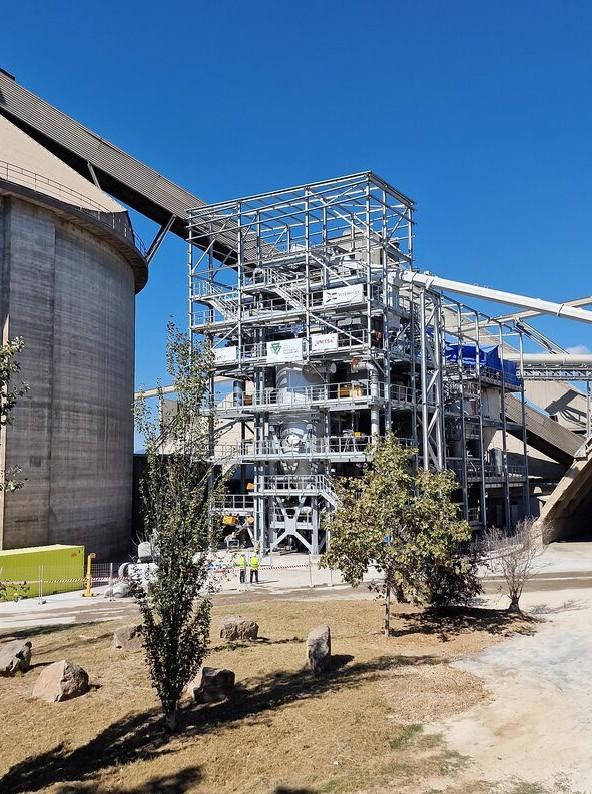
Currently, the company has three gasification projects under commissioning, expected to enter operation in the first half of 2026 in the meat, paper, and cement sectors. According to Ponce, gasification has proven particularly effective in handling waste streams that do not fit easily into other treatment routes.
“In the meat rendering sector, we found a strong opportunity — this is a residual fuel with high chlorine or sulfur content, which is complex to manage,” he explains.
In the paper industry, the solution involves valorizing pulper rejects together with biomass to generate steam and replace natural gas. In cement plants, Syngas produced from refuse-derived fuel (RDF) is injected into the kiln through an additional line to reduce petroleum coke consumption.
These projects do not require dismantling existing installations. Instead, a parallel system is added, enabling the substitution of between 50% and 100% of fossil fuel consumption, depending on the case.
“These are highly circular projects, as they prevent waste from going to landfill and instead use it as fuel to produce steam, reduce natural gas consumption, and lower emissions,” Ponce notes.
Regulation is also tightening. By 2035, only 10% of municipal waste in Europe will be allowed to go to landfill. While this target does not directly apply to industrial waste, it reflects a broader trend toward reducing landfill use and increasing valorization. In Spain, around 30–35% of municipal waste is still landfilled, indicating growing pressure to find solutions for industrial waste streams that cannot be recycled.
Ponce argues that simply increasing incineration is not the answer, advocating instead for solutions capable of valorizing mixed biomass and waste streams where recycling is not viable and there is industrial demand for thermal energy.
What Gasification Brings Compared to Other Options
Gasification has historically suffered from the failure of early projects, particularly those using Syngas in internal combustion engines for electricity generation.
“The main issue wasn’t the gasifier itself, but the cleaning of the Syngas,” Ponce explains.
Problems with tar condensation and gas variability affected engine reliability.
Air-blown gasification typically produces Syngas with around 10–15% hydrogen, similar levels of carbon monoxide and CO₂, about 5% methane, and a large nitrogen fraction (around 50%). This makes it suitable for generating steam, thermal fluids, or hot air.
In operation, Ponce highlights three advantages over direct combustion. The first is flexibility in handling fuel variability, which is key when working with heterogeneous waste. In this scheme, thanks to the prior treatment of the syngas, “the boiler doesn’t get as dirty, doesn’t corrode as much… and has a longer service life.”
The second is tar management.
“In the projects we are carrying out, there is no condensed tar. We have managed to prevent it from condensing,” he notes.
The process is configured to keep them in the gaseous phase and oxidize them along with the rest of the Syngas when it is used in boilers or industrial furnaces.
The third is environmental: Ponce states that they have not detected the formation of dioxins or furans.
“We are below the detection limits,” he states.
According to him, the process configuration (multi-stage gasification followed by controlled oxidation of the syngas) avoids the temperature and partial oxidation conditions that normally favor the formation of these compounds, even when processing waste with a high chlorine content.
Three Pathways for Syngas Utilization
WtEnergy Advanced Solutions develops three main Syngas applications:
- SynTH (Syngas-to-Heat): for industrial thermal applications
“We produce Syngas, partially clean it, and then burn it in a controlled way with low CO and NOx formation, no slagging, to generate steam or heat,” explains Ponce. - SynTK (Syngas-to-Kiln): for use in industrial kilns such as cement or lime plants.
- SynTX (Syngas-to-X): for producing higher-value molecules such as hydrogen or methanol.
To advance this last pathway, the company participates in the HYIELD project, which uses steam and oxygen gasification of biowaste to produce high-quality Syngas with around 50% hydrogen, 30% CO, and 20% CO₂, without nitrogen dilution.
“The goal is to demonstrate low-cost green hydrogen production—below €3/kg,” Ponce explains, targeting users currently priced out of the market, where hydrogen ranges between €5 and €8/kg.
The company aims for a decentralized model, “producing energy where it is needed,” with small to medium-scale plants starting from 10 MWth and using local resources, without relying on future hydrogen pipelines.
“It’s not just about hydrogen — it’s about producing high-quality Syngas that can be converted into other molecules,” such as methanol or sustainable aviation fuel.
Ponce also notes that producing synthetic methane from Syngas is technically straightforward:
“There’s no technical limitation. Converting hydrogen and carbon monoxide into methane has been done for decades.”
He emphasizes that the decision depends on the market and incentives; for now, he sees greater potential in local hydrogen and in the synthesis of molecules such as methanol or sustainable aviation fuels, where the added value can justify the investment.
What Makes Gasification Competitive Today
Gasification also enables the treatment of non-fermentable materials, particularly lignocellulosic biomass and complex waste streams that are not suitable for anaerobic digestion.
“They work with fermentable organic matter; we work with lignocellulosic material,” Ponce explains, comparing gasification to biogas.
Within HYIELD, the company will test gasification of dry digestate and certain stabilized municipal waste fractions that currently have limited alternatives beyond landfill.
“We are not competing with recycling or other solutions—but there is a large volume of material that needs an outlet,” he emphasizes.
Industries with the highest potential for gasification include those with high thermal demand and access to biomass or waste streams: paper, chemicals, ceramics, metallurgy, and cement. In many cases, the starting point is waste management cost.
“Often the alternative is paying for landfill or incineration. Our solution is economically more attractive than landfill,” Ponce explains.
The rising cost of CO₂ also plays a role:
“As CO₂ prices increase, awareness will follow.”
He also sees a shift in industrial mindset:
“Years ago, we were knocking on doors to explain that they had a problem. Now many companies know they have to do something. Some are clear about it. Others still don’t know which solution fits best.”
He adds that electrification is not always feasible “due to temperature requirements or grid capacity,” and in those cases, dispatchable renewable heat gains ground.
In economic terms, Ponce insists that “what really determines viability is the price of the fuel.” For biomass, he places typical reference values between €20 and €28 per MWh; for certain complex waste streams, the cost can be very low, around €5 per MWh, in addition to the savings compared to landfill or incineration alternatives.
From a bankability perspective, the main challenge is not so much regulatory as it is CAPEX and risk perception. To reduce this, the company focuses on sector references, replicability, and shared investment models. “The client doesn’t have to make the full investment. We can invest alongside them so they can start saving from day one,” he explains. The development timeline for an industrial project is usually between one and two years, although “there are companies that know they will do it, but still don’t feel the urgency.”
Ponce acknowledges that social acceptance also plays a role when it comes to waste.
“It’s normal for people to get nervous when they hear the word ‘waste”, he admits, and he advocates for transparency regarding the process, monitoring, and emission limits.
For WtEnergy Advanced Solutions, bio-Syngas is a versatile tool: it can replace natural gas in boilers, reduce petroleum coke use in cement plants, valorize complex industrial waste, and, in the medium term, become a pathway for producing renewable molecules.
Recent Posts
Related posts
Biomass gasification: far more benefits than traditional biomass boilers
Biomass gasification offers higher efficiency, greater flexibility, and carbon capture compared to traditional boilers, improving industrial profitability.
Europe will only be able to decarbonize its industry if it sees waste as a resource
As capital drives waste valorization, innovative technologies are accelerating the transition to net zero.
WtEnergy raises €10 million to scale its gasification technology
WtEnergy has closed a €10 million funding round to accelerate the deployment of its gasification technology for industrial waste and biomass.
Do you want
to know more?
Request a meeting with our team and they will give you a technical and economical evaluation for your plant.