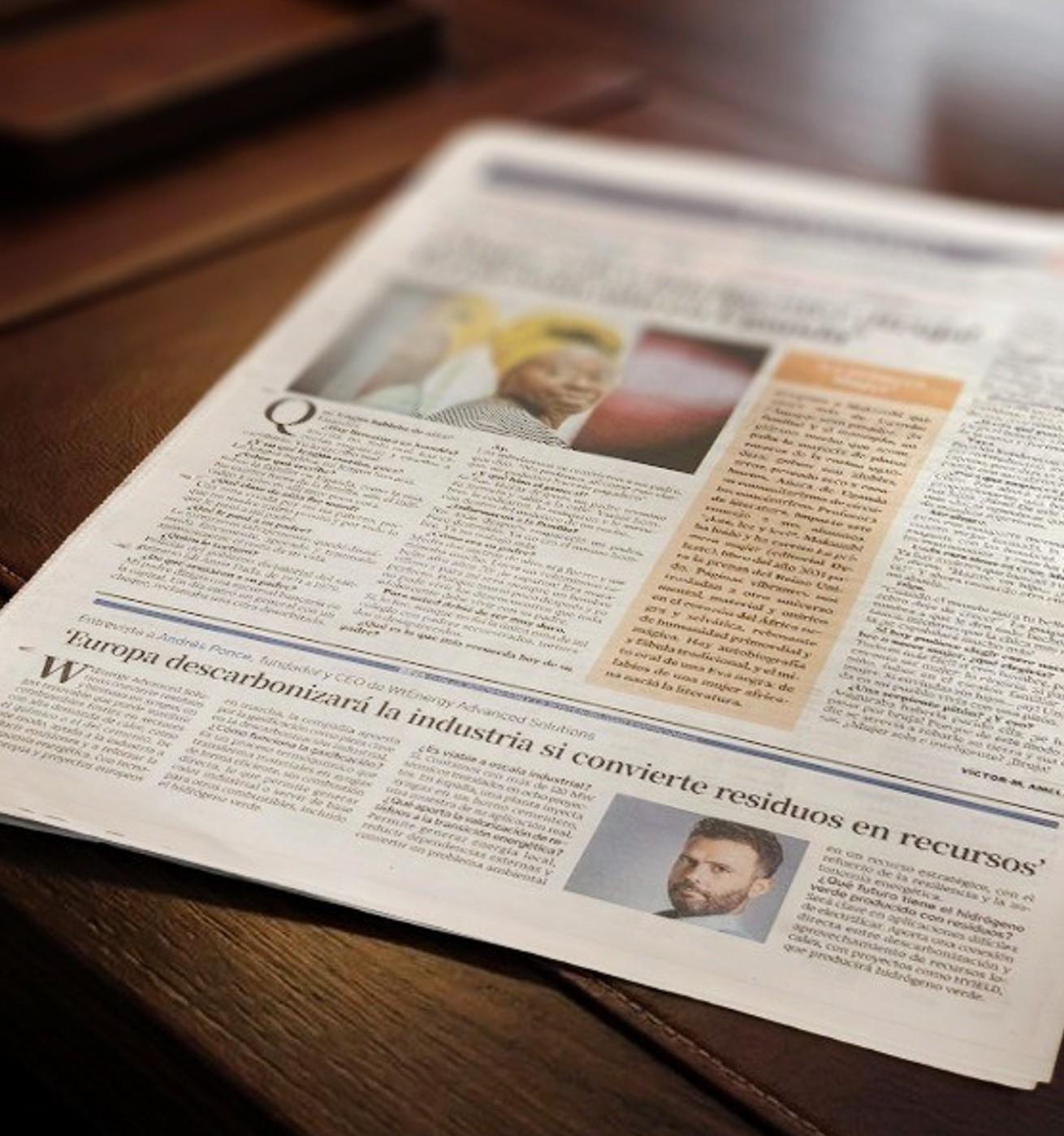
Article published in La Vanguardia on April 9, 2026, in the Innovation and Corporate Sustainability section.
WtEnergy Advanced Solutions was founded in Barcelona in 2017, building on more than two decades of experience in gasification and clean energy by Andrés Ponce, with a clear vision: to transform waste into renewable gas to help industry reduce emissions and gain energy independence. The company addresses a dual European challenge—reducing dependence on fossil fuels and valorizing underutilized waste—through a model based on innovation, circularity, and real industrial-scale application. In 2019, Antonio Crous joined as co-founder to drive its development. Today, the company has proprietary technology to convert waste and biomass into renewable synthesis gas, or syngas, and participates in European green hydrogen projects.
How would you define the company’s activity and the solutions you offer?
We help industry transform waste into energy and, in doing so, into a source of competitiveness. To achieve this, we design gasification technology capable of converting waste and biomass into a renewable gas that can replace fossil fuels. We focus on sectors with high heat demand, such as cement, ceramics, and chemicals, where electrification is not always viable. Overall, our solution reduces emissions while strengthening energy autonomy.
How does gasification work and what are its applications?
It is a thermochemical process that converts materials into synthetic gas through a controlled reaction. Unlike conventional combustion, it does not involve burning but extracting energy value more efficiently. As a result, syngas can be used to generate industrial heat or as a base for other fuels, including hydrogen. This makes it possible to transform complex waste into a stable, local energy source.
Where are the biggest opportunities for decarbonization today?
They are concentrated in industries with high continuous heat demand, such as cement, chemicals, and metallurgy. In these sectors, electrification is complex and emissions are high, so the transition requires broader solutions. Decarbonization does not depend on a single technology, but on a combination of efficiency, electrification, renewable fuels, hydrogen, and waste valorization. The latter allows progress on two fronts: reducing emissions and strengthening energy independence.
“The major challenge will be advancing decarbonization without compromising competitiveness or security of supply.”
Andrés Ponce
Founder and CEO of WtEnergy Advanced Solutions
Is it feasible to replace fossil fuels with syngas at an industrial scale?
Yes, it already is. We currently have more than 120 MW of thermal capacity installed across eight projects. In Spain, we have launched a facility that injects syngas into a cement kiln, demonstrating its integration into real industrial processes. Going forward, expansion will depend on factors such as waste quality and regulatory frameworks. However, partial substitution of fossil fuel consumption is no longer hypothetical—it is becoming a reality.
What role does waste valorization play in energy security?
It plays a key role by enabling local energy generation from available resources and reducing dependence on imports. While it will not solve the entire energy system on its own, it contributes to resilience, diversifies the energy mix, and helps limit cost volatility. At the same time, it turns an environmental problem into an economic resource, reinforcing its strategic value.
Has the industry embraced the circular economy paradigm?
Industry understands that change is necessary, although it has not yet fully integrated it into investment decisions. However, perceptions have clearly evolved: waste is no longer seen solely as a cost, but also as a resource. The next step is to scale this approach and turn it into replicable and profitable industrial models.
What role will green hydrogen produced from waste play?
It will play an important role, especially in applications that are difficult to electrify. Producing hydrogen from waste connects decarbonization with the use of local resources. We are involved in the European HYIELD project, which aims to produce more than 400 tonnes of green hydrogen. Initiatives like this point toward a model with strong scalability and competitiveness potential.
What technologies will define the energy system in the next decade?
There will not be a single solution. Rather, we will see a combination of renewables, storage, efficiency, and electrification where feasible. In industry, this mix will be complemented by waste valorization for heat generation, the use of renewable gases, and hydrogen for specific applications. The key challenge will be advancing decarbonization without compromising competitiveness or security of supply.